Posts

Diary of a Homeschool Dad: Week 3

Image
What a week this turned out to be!  Laura decided to take a chunk out of our schedule, so we had to do some on-the-fly adjusting.  Here's how week 3 played out in our house. Sunday - This marked the final service that is planned to be entirely online, as in-person church resumes next week.  Which also means we've enjoyed our last sermon in shorts and bare feet!  As everyone has gotten into a nice routine of getting up early, it is certainly much easier to be awake in advance of the early start time, and we all seem to be ready and willing to set those alarms even earlier soon to be in the sanctuary for real.  Everyone's Zoom meetings went well and the older two girls (Mrs. Geo and Girly) even got some mall time in.  Shopping is still a necessary event for the ladies of the house, you see. Monday - With our local school district actually beginning classes today, this was the first day that Mrs. Geographist got to teach her students.  The load was suppos...

Diary of a Homeschool Dad: Week 2

Image
Last week you got to meet the main characters in our play, and as the weeks go by we'll figure out if the tale will be drama, comedy, or action.  I'm betting it will eventually include all three, like some grand epic that Cecil B. DeMille or David O. Selznick would be proud to produce.  Starting with last weekend, let's get into how this cycle went down. Saturday - Girly had a cello lesson in the morning, which is always a good way to burn off the early part of the day (and when you're talking a SE Texas August, "burn" is the appropriate word choice).  Speaking of our oldest kid and driving, this is the day she began taking driver's ed online.  We're doing the at-home option, because these days who is really excited about jumping into a car with a stranger and breathing the potentially-Covid-inducing air?  Now we wait and see how long it will take her to get the requisite 6 hours of instruction before she's ready to schedule a DPS visit to obtain a...

Diary of a Homeschool Dad: Week 1

Image
A quick glance at headlines at any point over the past six months would suggest we're living in an unusual time.  And since I've already got this website, it seemed that the start of the 2020-21 school year might be a great time to document what life looks like to me right now.  The whole world is going through an interesting moment together, so this blog will take a brief excursion to see what is going on with an average family living just outside of Houston, TX. First of all, let's take some time to meet the main characters.  In case you're new to this page, my name is Brian.  I am fascinated by all things history and geography, hence the name of my page and my nickname "Geographist".  By profession I'm a cartographer (yes, that's a map maker) and have worked in various segments of the petroleum industry for my entire 18 year career.  I'm active in my church, where my wife and I serve as 5th grade Bible study directors, I play the cello in the or...

Boston: Abiel Smith School

Image
This will be the final post about Boston for a little while.  I'm putting the historic city on hiatus for a period of time to focus on something new going on in the Geographist household - as school begins for all four girls in my home (my wife will be teaching virtually, the oldest two kids are attending in person, and the youngest is homeschooling) I start a new chapter as the stay-at-home dad because my employer's local office has not reopened.  Yes, that makes me a homeschool dad!  And while Boston may have tons of history to learn, it seems important to acknowledge what a unique moment in history we're experiencing right now, and so I will attempt to document how we do things in 2020 during the coming months. But until then, let's focus on the next stop along the Black Heritage Trail...and that is the Abiel Smith School. We've already seen a mention of the Abiel Smith School in previous posts, as it was an important location for the education of the African Ame...

Boston: Smith Court Residences

Image
This week, as we approach the end of the Black Heritage Trail in Boston, we come to a group of houses.  Unlike some of the previous homes that we have studied, and that have merited enough attention to be placed under the care of the National Park Service, these locations are much less a story of person and much more a study of place and time.  The various developments that occupy Smith Court, in fact, reflect the changes that occurred in Boston through three centuries of growth and migration within the Beacon Hill neighborhood. Five historic homes stand along the small, dead-end road that cuts off of Joy St. and while they all represent life for residents in this part of town during the 19th century, they nevertheless vary quite a bit by age.  In fact, walking the street that is less than 150' long will take you through nearly that many years as the oldest surviving home was built in the late 18th century, and the apartments on the corner weren't completed until well int...

Boston: John Coburn House

Image
As we visit another home along Boston's Black Heritage Trail, we have the opportunity to see the impact that affluence can have on a worthy cause.  The builder and first resident of the home at 2 Phillips Street was John P. Coburn, one of Boston's wealthiest African-American residents.  A native of the city, he not only provided evidence that black men could be successful entrepreneurs, but also used his abundant resources to assist the cause of freedom. John Coburn originally worked as a housewright - a term that included construction and repair of homes - but as a young man made a change to the clothing industry that employed many African-Americans.  After his business outgrew his home, he expanded to run a pair of stores on land that is now home to Boston's City Hall, possibly assisted in this venture by his white father, also named John.  By the time Coburn was in his young 30s he had become prosperous enough to hire a well-known architect by the name of Asher Be...

Boston: Lewis & Harriet Hayden House

Image
If you won your freedom, would you be more likely to protect it at all costs or to risk it in order to save others?  This week we look at the life and home of a man and his wife who took the more heroic path.  Lewis Hayden and his wife Harriet spent their lives in Boston fighting for fugitive slaves from their home in the Beacon Hill neighborhood - a fight that had an especially personal meaning to Lewis, a former slave himself. Lewis Hayden was born in Lexington, KY, to a family of 25 slaves.  He had two early life experiences that helped him determine his worth: first, at the age of 10 he was traded by his first owner for a pair of carriage horses which was his market value, and then later at the age of 14 he happened to meet Revolutionary War hero Marquis de Lafayette, who tipped his hat to the boy and gave him a sense of his real value as a person.  His first wife, named Esther, and their child were bought by Senator Henry Clay and then sold again, separating the...

Boston: Charles Street Meeting House

Image
Throughout Boston history, meeting houses have been important places.  Whether originating as churches or civic gathering points, they have long served as sources of information.  From Faneuil Hall to the Old South Meeting House, we've already looked at how certain locations have been critical to how Bostonians have come together to form opinions, exchange ideas, and mold their society.  The site we will discover this week symbolizes the city's struggle with race in faith, much as the Phillips School represented the fight for equal education. Built during the first decade of the 19th century along the waterfront at the edge of Beacon Hill (before additional land was filled in along Charles River), the original congregation that met at the corner of Mt. Vernon St. and Charles St. was that of the Third Baptist Church.  As with most locations at that time, segregation existed.  Pews were only sold to white members, and black attendees at services had to sit in the ...

Boston: John J. Smith House

Image
First of all, happy Independence Day!  I hope you had a chance to celebrate "liberty and justice for all" this past weekend.  Second, my apologies because I am on vacation and do not currently have access to the maps that I usually use to supplement the posts on this site.  I'll be sure to add a map when I am able, just so you can find out a little more about the site we are discussing today: the John J. Smith house. On the south side of Pinckney Street, just down the street from the Phillips School that we discovered last week, sits the home of John J. Smith.  His first stint in Boston was short-lived, as he arrived in town in 1848 but quickly left for California in search for riches during the Gold Rush.  It was probably to many people's benefit that he never found riches, because upon his return to Massachusetts he not only opened up a barbershop in his neighborhood but also began making positive changes within his community.  In 1850, he supported Benja...

Boston: Phillips School

Image
Last week we learned about George Middleton and I mentioned that one of the causes he supported was that of equal education rights.  Throughout the majority of Boston's history schooling was racially segregated, as it was across most of America.  One of the most visible symbols of that struggle, and the eventual success that was found from years of effort, is the Phillips School. Originally built in 1824, the school on the corner of Pinckney and Anderson Streets first housed the English High School - America's first public high school, which had been founded just three years earlier.  The school only admitted white males, although a school for girls was also established in 1824.  By 1844, English High School had moved to downtown Boston (next to Boston Latin School), and the building in Beacon Hill was converted to a grammar school.  The new Phillips Grammar School was named after Boston's first mayor, John Phillips, and remained a white-only school because all ...

Boston: George Middleton House

Image
If you take up arms to fight for the freedom of a nation, what sort of personal freedom do you expect in return?  This week we take a look at the home of a man who answered that very question.  Like several homes along the Black Heritage Trail, the building at 5 Pinckney St. in Beacon Hill is a private residence today and is therefore not available for touring, but the site remains an important one for the community. George Middleton was approximately 40 years old when the first shots of the American Revolution were fired.  Born at some point in 1735, the exact month and day are unknown.  He chose to fight alongside his countrymen as a Patriot against the British, and was in command of a unit that was known as the Bucks of America.  This group was one of very few all-black companies in Massachusetts during the American Revolution, and although war records are incomplete and do not detail what action they saw, it is believed that Middleton (the only member of the...

Boston: 54th Regiment Memorial

Image
At the edge of Boston Common, directly across Beacon Street from the Massachusetts State House, stands a bronze memorial set in marble.  The image depicts a single mounted officer alongside his marching troops - the men who, at this very location, marched into history on May 28, 1863.  It is Colonel Robert Gould Shaw leading his men to war, and those troops are the 54th Regiment Massachusetts Volunteer Infantry.  The Civil War began in the spring of 1861, and within a week of the first shots being fired at Fort Sumter, SC, a young man from a wealthy Boston family had enlisted to serve in the Union army.  Within 18 months, young Robert Gould Shaw had fought in several battles (including Antietam), been wounded twice, and had been promoted from private to second lieutenant to captain.  Any cause for celebration that his upward mobility provided, however, would likely have been tempered by the relative lack of success for the Northern troops.  A war that both ...

Boston: Black Heritage Trail

Image
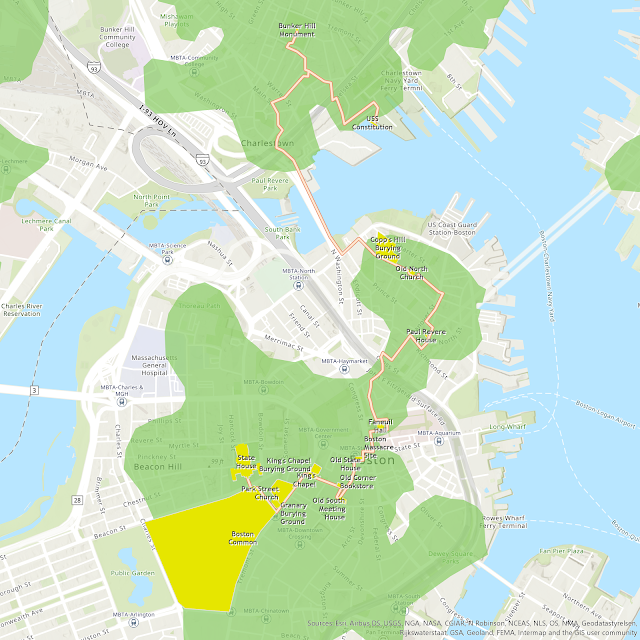
Did you know that Boston has additional trails to travel?  Does it surprise you that they have one dedicated to the city's African American population?  A city that prides itself on being the Cradle of Liberty nevertheless has a complicated history for minorities, and the Black Heritage Trail that branches off from the Freedom Trail between Boston Common and the Massachusetts State House serves to inform visitors about that past. Boston's history with the black community goes back almost as far as that of its European inhabitants.  The first recorded landowner of African descent within modern Boston's city limits was Bostian Ken.  His home (and at least four acres of land) were purchased in 1656 as part of Dorchester, a town just south of the city that was annexed by Boston in 1870.  A former slave himself, Ken actually mortgaged his property to purchase the freedom for another slave for the sum of 32 pounds - a move that also earned him the designation as the f...

Boston: Freedom Trail Recap & Skinny House

Image
And so we've come to the end of the Freedom Trail.  This set of 16 sites has helped define one of the most significant cities to our nation's history.  But we are not finished with the town itself, because as time has passed Boston has continued to reinvent itself into the city of today. As we move into the next several weeks, we're going to look at many of these additional sites that make Boston what it is today, as well as dig more deeply into the physical changes of the city itself.  Just for fun this week, I thought it might be enjoyable to spend a minute looking at a small-but-interesting location that has become iconic for citizens.  The Skinny House, located in Boston's North End across the street from Copp's Burying Ground, is a famous spite house - one built not for function, but for anger or revenge.   Measuring roughly 10 feet wide and 30 feet long, this four-story home constructed in 1884 sits on a mere 0.03 acres.  The common rumor is that...

Boston: Bunker Hill Monument

Image
It is fitting that we come to the end of the Freedom Trail in Boston at Bunker Hill this week.  The skirmishes along the roads to Lexington and Concord may have provided the first armed conflict of the American Revolution, but the Battle of Bunker Hill was the first organized battle of the war.  It is seemingly appropriate that we close out Memorial Day weekend at the location of the memorial to our nation's first soldiers.  Lexington, Concord, and Bunker Hill cost 164 American lives - the first military blood spilled in the struggle to create the nation we call home. The Bunker Hill Monument is a stone obelisk rising 221 feet above...Breed's Hill.  That's right, most of the fighting occurred, and the memorial is therefore placed, upon Breed's Hill.  The battle itself was named after another hill north of Charlestown, which is where the commanders of the Colonists (Colonel William Prescott and General Israel Putnam) were initially ordered to secure.  ...

Boston: USS Constitution

Image
This week we cross the water where the Charles River empties into Boston Harbor, much as Paul Revere did all those years ago.  Our destination is the oldest commissioned naval vessel in America (and oldest currently afloat in the world), USS Constitution - a ship that was built, interestingly, using fastening bolts and copper sheathing provided by Revere himself!  She resides in the Charlestown Navy Yard as the namesake of the USS Constitution Museum, and is still crewed by naval officers to "preserve, protect and promote" both her and the U.S. Navy. When Americans finally achieved independence, it became clear that a naval presence would be necessary to protect the assets and interests of the fledgling nation.  After the Continental Navy was disbanded following the war, the remaining ships had been sold to help pay debts (although only 11 of the original 65 boats had survived the war).  Launched in 1797 from Edmund Hartt's shipyard in Boston, USS Constitution r...

Boston: Copp's Hill Burying Ground

Image
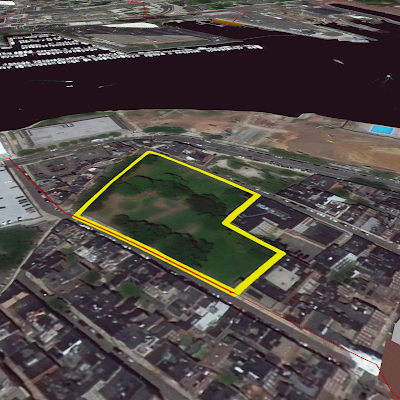
The third and final cemetery along the Freedom Trail sits near the northern end of the city, and is the second-oldest burial site in Boston.  Copp's Hill Burying Ground is the final stop of the Freedom Trail that sits on the Shawmut Peninsula, the original extents of the city, and is perched on one of three hills that rise above the surrounding land and harbor.  Formerly known as the North Burying Ground, this plot of ground has served as the final resting place of Boston residents since 1659 and is the largest of the town's colonial cemeteries. Copp's Hill was a tactically important location for the British during the American Revolution, as it provided a vantage point from which cannon could be fired towards Charlestown across the river.  During the Battle of Bunker Hill, artillery posted at this location fired on colonial fortifications atop Breed's Hill, apparently to little effect.  It is said that British infantry used the grave markers within the Copp's Hil...

Boston: Old North Church

Image
From the high steeple to the underground crypts, this week's stop along the Freedom Trail has history from top to bottom.  And from the sweet colonial chocolate to a spicy controversy, there remain plenty of delicious reasons to visit.  The Old North Church remains a house of worship and one of the most-visited historical locations in Boston. Standing longer than any church in town since its construction in 1723, "Old North" was officially named Christ Church in the City of Boston.  There were actually two different locations known as "Old North" - in addition to Christ Church, there was also a Congregationalist meeting house that was led by such men as Increase Mather (note that I've corrected my error from last week mistaking these two!).  The second church was torn down by the British in 1775 for firewood, and there are some who believe that structure, which stood diagonally across the street from Paul Revere's home, was the real location of the lan...

Boston: Paul Revere House

Image
This week's stop along Boston's Freedom Trail is our first location within the downtown district.  In fact, it is now the oldest building still remaining in downtown Boston, having been built in 1680.  And because it is a home (the only one along the Freedom Trail) it gives us a unique look at life during the American Revolution - the life of a citizen, a businessman, and a patriot. The address is 19 North Square and, while the building is old, it had an interesting history prior to the construction of the current structure.  From 1670-1676 the site was home to the famous theologian Increase Mather, who was influential to the city as the minister of Second Church as well as later becoming the president of Harvard.  A fire destroyed the original house, but a new one was built by a new owner just a few years later.  Robert Howard was a wealthy merchant who purchased the land from the church and had a two-story townhouse constructed (and I will later point you to...